What is speed to lead and why does it matter?
Speed to lead is the time between a prospect submitting an inquiry and the first meaningful response from your business. The most widely cited research (a Harvard Business Review study of 2,241 US companies and the MIT and InsideSales.com lead response study) found that responding within five minutes makes a lead roughly 21 times more likely to be qualified than responding after 30 minutes, and that firms responding within an hour are about seven times more likely to qualify the lead than firms that wait longer. Yet the average business takes more than 40 hours to respond, and many never do.
- Within 5 minutes: roughly 21x more likely to qualify the lead than after 30 minutes (MIT / InsideSales.com lead response study).
- Within 1 hour: about 7x more likely to qualify than responding after an hour (Harvard Business Review, 2,241 companies).
- Average corporate response time in that research: 42 hours; nearly a quarter of companies never responded at all.
- Automated WhatsApp, SMS and email follow-up within 60 seconds is how high-ticket funnels collapse response time to zero.
Every dollar you spend on Meta ads buys attention that decays by the minute. A prospect who fills out your application is, at that moment, thinking about their problem, your offer and nothing else. Thirty minutes later they are in a meeting, scrolling a competitor, or convinced the form went nowhere. The statistics on lead response time have been consistent for over a decade, and they are brutal for anyone who treats follow-up as a task for later. This guide collects the speed to lead numbers that matter for high-ticket offers, explains the mechanism behind them, and lays out the automated follow-up stack that responds in under a minute without a human in the loop.
1. The Core Speed to Lead Statistics (and Where They Come From)
Three Studies That Keep Getting Confirmed
Harvard Business Review's 'The Short Life of Online Sales Leads' audited 2,241 US companies by submitting a web form and timing the response. Firms that responded within an hour were nearly seven times as likely to have a meaningful conversation with a decision-maker as those that waited even an hour longer, and more than 60 times as likely as companies that took 24 hours or more. The average response time among companies that did respond was 42 hours. About 23% never responded.
The MIT and InsideSales.com lead response management study, the most quoted data set in the category, found the odds of qualifying a lead drop roughly 21-fold when first contact moves from five minutes to 30 minutes, and the odds of simply reaching the lead fall about 100-fold after the same window. The first five minutes are not just better; they are a different game.
A series of follow-up industry analyses (Lead Connect, Velocify and others) have added the number most sales leaders remember: somewhere between 35% and 50% of sales go to the vendor that responds first. For a high-ticket offer where the prospect may also have applied to two competitors, being first is often the whole advantage.
The direction of these findings has been replicated across industries and years. The exact multipliers vary by data set, but no credible study has found that waiting improves outcomes.
2. Why Response Time Has an Outsized Effect on High-Ticket Offers
Intent Decay, Context Loss and the Competitor Window
Intent decays fast. A prospect who just watched your 12-minute VSL and completed a qualification application is at peak clarity about their problem. Every minute that passes, that clarity is diluted by other work. Contacting them while the context is still loaded means the conversation starts at step five instead of step one.
High-ticket buyers compare. Someone investing $5,000 to $25,000 rarely applies to a single provider. If a competitor's automation confirms the application and books the call within a minute while your team replies the next morning, the prospect has already anchored on them.
Slow follow-up also signals operational quality. Prospects reasonably assume that if you take a day to acknowledge a request to give you money, delivery will be slower still. Fast, personalised follow-up is the first proof of your unique mechanism.
Finally, the no-show problem begins at the response. Calls booked without immediate confirmation and nurture show at 50% to 60%. Calls confirmed instantly and reminded through WhatsApp show at 80% or more.
A lead's probability of being reachable is highest in the first five minutes and falls off a cliff by hour one. Response time is the only pipeline variable you can take to zero with automation.
3. Speed to Lead Benchmarks: What Good Looks Like in 2026
From Industry Average to Automated Instant
Industry average (manual, inbox-driven follow-up): 24 to 48 hours. This is where most service businesses sit, and it is why paid traffic 'does not work' for them.
Dedicated SDR or setter working business hours: 15 minutes to 4 hours depending on load, with nights and weekends uncovered. Roughly 40% of inbound applications on high-ticket funnels arrive outside working hours.
Automated multi-channel follow-up: under 60 seconds, 24 hours a day. A booking confirmation, a personalised video or voice note, a case study and a calendar reminder go out across WhatsApp, SMS and email the moment the application is submitted. A human then joins the thread during business hours.
The benchmark for a modern high-ticket funnel is the third tier. Anything slower is leaving booked calls on the table that you already paid Meta to generate.
- Target: first automated response within 60 seconds of application, every hour of every day.
- Target: human reply inside the same thread within 15 minutes during business hours.
- Target: show-up rate above 80% with a three-touch pre-call sequence.
- Measure: time-to-first-response, time-to-first-human-response and show-up rate, weekly.
4. The 60-Second Follow-Up Stack That Removes the Human Bottleneck
What Fires, On Which Channel, in What Order
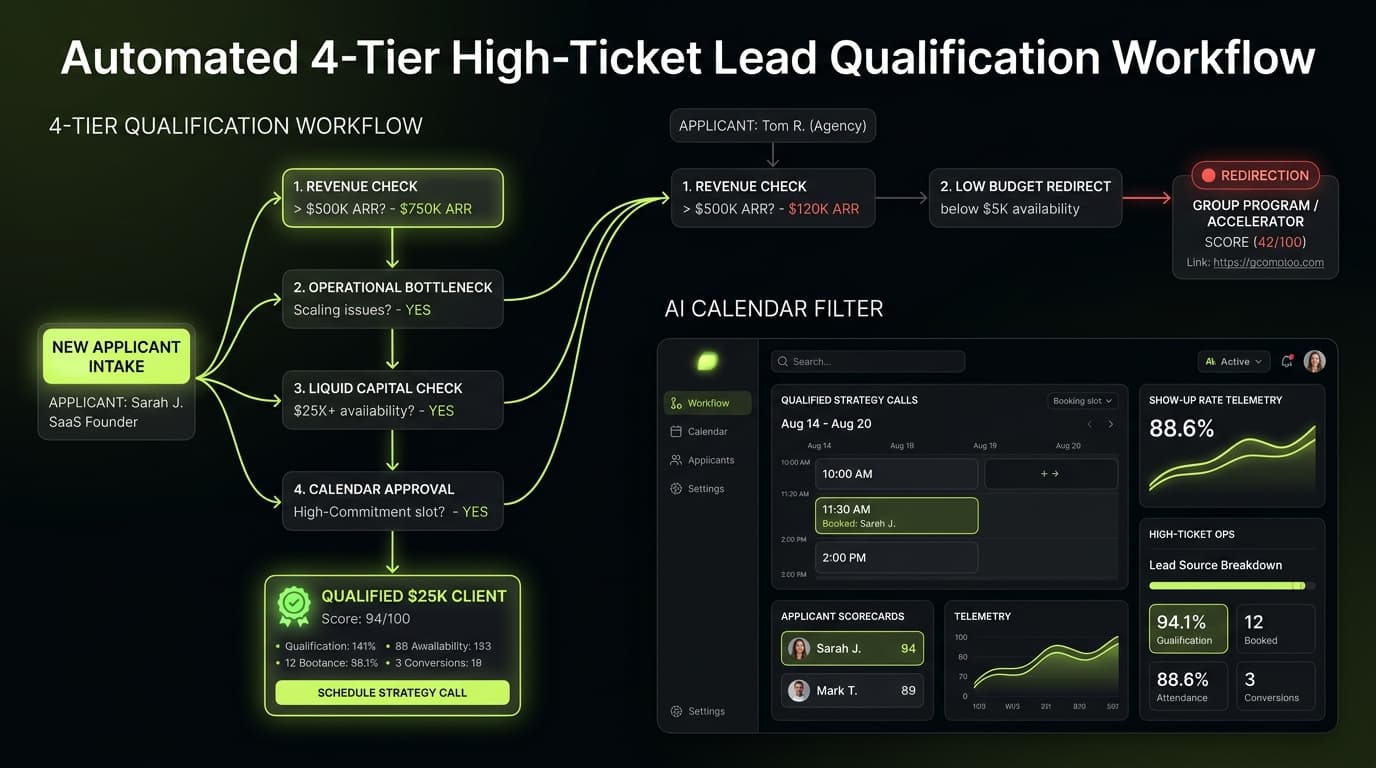
Trigger: the qualification application is submitted. The CRM scores the answers and routes qualified applicants to the booking path, unqualified applicants to a resource path.
Touch 1 (0 to 60 seconds): WhatsApp message with a personalised confirmation and a link to the calendar if the prospect has not yet booked. WhatsApp open rates sit around 98% and response times are measured in seconds, which is why it leads the sequence.
Touch 2 (0 to 60 seconds): SMS fallback with the same booking link, for the minority of prospects without WhatsApp, and an email that recaps the offer, the next step and a relevant case study.
Touch 3 (2 to 5 minutes, if unbooked): an AI assistant answers common questions in the thread, confirms fit and nudges toward a time slot. If the prospect replies with anything that needs judgment, the thread is handed to a human setter with full context.
Touch 4 (24 hours before the call): a short case study matching the prospect's niche. Touch 5 (60 minutes before): a reminder with the meeting link and one sentence on what to prepare.
5. How to Audit Your Own Speed to Lead This Week
A 30-Minute Test That Usually Hurts
Submit your own application form from a personal number and email on a weekday evening. Start a timer. Record when the first automated message arrives, when the first human message arrives and when, if ever, someone proposes a time.
Repeat on a Saturday morning. Most businesses discover that weekend applications are not touched until Monday afternoon, a 40-plus-hour response time on leads that cost the same as weekday leads.
Pull the last 30 days of applications from your CRM and calculate the median time-to-first-response and the show-up rate. If the median is above 15 minutes or the show-up rate is below 75%, the fix is automation, not more reminders to the sales team.
Then compare cost per booked call before and after automation. Across our accounts, moving from manual to automated 60-second follow-up typically lifts booked-call volume from the same ad spend by 30% to 45%, which is the cheapest cost-per-call improvement available.
- Mystery-shop your own funnel on a weekday evening and a weekend morning.
- Measure median time-to-first-response and show-up rate for the last 30 days.
- Automate the first three touches before hiring another setter.
Strategic Conclusion
The speed to lead statistics have not changed in over a decade because the mechanism has not changed: attention and intent decay by the minute, and the first responder wins a disproportionate share of high-ticket deals. The modern answer is not a faster sales team but an automated stack that confirms, nurtures and books within 60 seconds, then hands a warm, pre-sold prospect to a human. QualifiedLeadsX installs that stack as part of its appointment setting system, alongside the qualification filter and the Meta campaigns that feed it. If your median response time is measured in hours, book a free strategy call and we will show you the exact sequence we would deploy.
Common Questions Answered
What is a good speed to lead?
Under five minutes is the research-backed threshold, and under 60 seconds is the practical standard for automated high-ticket funnels. Anything over an hour puts you in the same bracket as businesses that effectively do not follow up.
Does speed to lead still matter if the prospect has already booked a call?
Yes. Immediate confirmation and a short pre-call nurture sequence are what move show-up rates from the 50% to 60% range to above 80%. The booking is only valuable if the prospect shows.
Which channel should the first response use?
WhatsApp first where the prospect has it, because of near-universal open rates and second-level response times, with SMS and email fired in parallel. Phone calls are effective but cannot be automated at 60 seconds around the clock.
How much does slow follow-up actually cost?
If your funnel generates 100 applications a month at $60 each and a 42-hour response loses even a third of the bookings you would otherwise get, you are discarding roughly $2,000 of ad spend per month and far more in unclosed revenue. The automation that fixes it costs a fraction of that.
Can an in-house SDR match automated speed to lead?
Not around the clock. A single SDR covers roughly 40 hours of a 168-hour week, and about 40% of high-ticket applications arrive outside those hours. Automation covers the gap; the SDR then adds judgment inside the warm thread.
QualifiedLeadsX™ Research Team builds and scales customer acquisition funnels for elite high-ticket coaches, consultants, and growth agencies. Over $150M+ in client revenue scaled across North America, Europe, and the Middle East.