How do you write a VSL script for a high-ticket offer?
A high-ticket VSL script runs 10 to 14 minutes and follows six acts in order: a qualifying hook (0:00–0:45) that names the audience and the outcome, problem agitation (0:45–3:00) that makes the cost of the status quo concrete, the failure of conventional alternatives (3:00–5:00), the unique mechanism (5:00–8:00) that explains why your approach works where others fail, proof (8:00–11:00) through specific case results, and a filtered call to action (11:00–12:30) that tells unqualified viewers not to apply. The goal is not to close the sale on video; it is to pre-sell the strategy call so qualified prospects arrive already convinced of the mechanism.
- Six acts, roughly 12 minutes: hook, problem, failed alternatives, unique mechanism, proof, filtered CTA.
- The first 45 seconds should qualify the viewer with a revenue or situation statement so unqualified viewers leave early.
- Spend the most time on the unique mechanism; it is what prospects repeat back on the call.
- End by telling people who should not apply, which raises application quality and close rate.
The video sales letter is the highest-leverage asset in a high-ticket funnel: it is watched by every prospect, it does the pre-selling that used to take three discovery calls, and it determines who applies. Most VSLs fail not because the offer is weak but because the script is a recorded pitch deck: features, pricing and a generic 'book a call'. This guide gives you the 12-minute, six-act structure we use for coaches, consultants and agencies, with timing for each act, what each one must accomplish, example lines, and the specific mistakes that depress application rates.

1. Before You Write: The Three Inputs Every VSL Script Needs
Audience Statement, Dominant Pain, Named Mechanism
Audience statement. One sentence that a qualified viewer recognises as themselves and an unqualified viewer does not. 'Agency owners doing $20K to $100K a month who are stuck on referrals' is a filter; 'business owners who want more clients' is not.
Dominant pain. Not a list of problems but the single costliest one, stated in the prospect's words and with a number attached: lost revenue, wasted spend, hours burned. If you cannot name it, interview five recent clients before writing a line.
Named mechanism. The proprietary method, framework or system that explains why your approach produces the outcome. It needs a name, three to five components and a reason each component exists. Without a mechanism, the VSL becomes a commodity pitch and the call becomes a price negotiation.
Gather proof while you are at it: three to five case results with specifics (niche, starting point, timeframe, outcome). Vague testimonials weaken Act 5; specific numbers carry it.
- Write the audience statement first; it becomes the hook and the CTA filter.
- Quantify the dominant pain before you agitate it.
- Name the mechanism and list its components before touching the script.
2. Act 1: The Qualifying Hook (0:00 to 0:45)
Name the Viewer, Promise the Outcome, Set the Timer
The hook has three jobs in under a minute: identify who the video is for, state the outcome in concrete terms, and tell the viewer what they will learn and how long it takes.
Example: 'If you run a B2B consulting practice billing between $15K and $80K a month and your pipeline still depends on referrals, in the next twelve minutes I will show you the three-step system we used to book 50 qualified calls a month for a firm just like yours, without cold outreach. If you are below $10K a month, this will not apply yet, and that is fine.'
Notice the explicit disqualifier. It costs a few views and raises the quality of everyone who stays. Meta's algorithm learns from watch time, so losing unqualified viewers in the first minute actually improves who the ads are shown to.
Do not open with your name, your story or your logo animation. Open with the viewer.
If the first ten seconds could be the opening of any competitor's video, rewrite them. Specific revenue bands, niche language and a numbered outcome are what stop the scroll.
3. Act 2: Problem Agitation (0:45 to 3:00)
Make the Status Quo Expensive
Agitation is not insulting the viewer; it is making the cost of their current situation concrete. Describe a typical month: the revenue swings, the hours spent prospecting, the feast-and-famine cycle, the proposal that went quiet. Use their vocabulary, not marketing vocabulary.
Attach numbers. 'If you are closing two clients a month at $5,000 and you could be closing six, that is $240,000 a year you are not collecting, and every month you wait is $20,000 gone.' Numbers turn a vague discomfort into an urgent decision.
Keep it to two minutes. Over-agitation reads as manipulation and causes drop-off; under-agitation leaves the viewer unconvinced that the problem is worth a $5,000 to $25,000 solution.
4. Act 3: Why the Usual Fixes Fail (3:00 to 5:00)
Close the Doors the Prospect Has Already Tried
Your prospect has already attempted solutions: a freelancer running ads, a cold email tool, a networking group, a course. Name each one and explain, respectfully, the structural reason it fails. 'Ads without a qualification funnel generate cheap leads who cannot afford you. Cold email is fighting spam filters. Referrals are not a system.'
This act does two things. It builds authority, because you clearly understand the landscape. And it pre-empts the objection 'we tried that', because you have already explained why that did not work and why your mechanism is different.
Be fair. If an alternative works for some businesses, say so and explain who. Overclaiming here costs credibility in Act 5.
5. Act 4: The Unique Mechanism (5:00 to 8:00)
The Three Minutes That Carry the Sale
This is where most of the pre-selling happens. Introduce the mechanism by name, then walk through its components in order, explaining what each does and why the sequence matters. For a client acquisition system: broad-targeted Meta creative that filters for intent, a VSL that pre-sells, a multi-tier qualification application, sub-60-second automated follow-up and a calendar that only qualified people can reach.
For each component, connect it to a failure from Act 3. 'Remember why ads alone fail? The qualification filter is what fixes that.' This is how the prospect learns to explain your system to their business partner.
Use a simple visual: a five-box diagram, a flow chart, a screen recording of the actual pipeline. Prospects who can picture the mechanism repeat it back on the call, and prospects who repeat it back close at far higher rates.
Do not price here. The mechanism sells the call; the call sells the engagement.
After watching, a prospect should be able to name your method and list its steps. If they can only say 'they do ads and funnels', the act needs rewriting.
6. Act 5: Proof (8:00 to 11:00)
Specific Results Beat Glowing Adjectives
Present three to five results in the same format: who they were, where they started, what was installed, what happened, over what timeframe. 'A home-services marketing agency, stuck at $30K a month on referrals, installed the system in week three and signed 235 clients over the following twelve months, $846,000 in contracted revenue at under $250 acquisition cost per client.'
Lead with the case closest to the viewer's situation. If you serve three niches, consider three VSL variants with the proof act swapped, which is cheap to produce and lifts conversion.
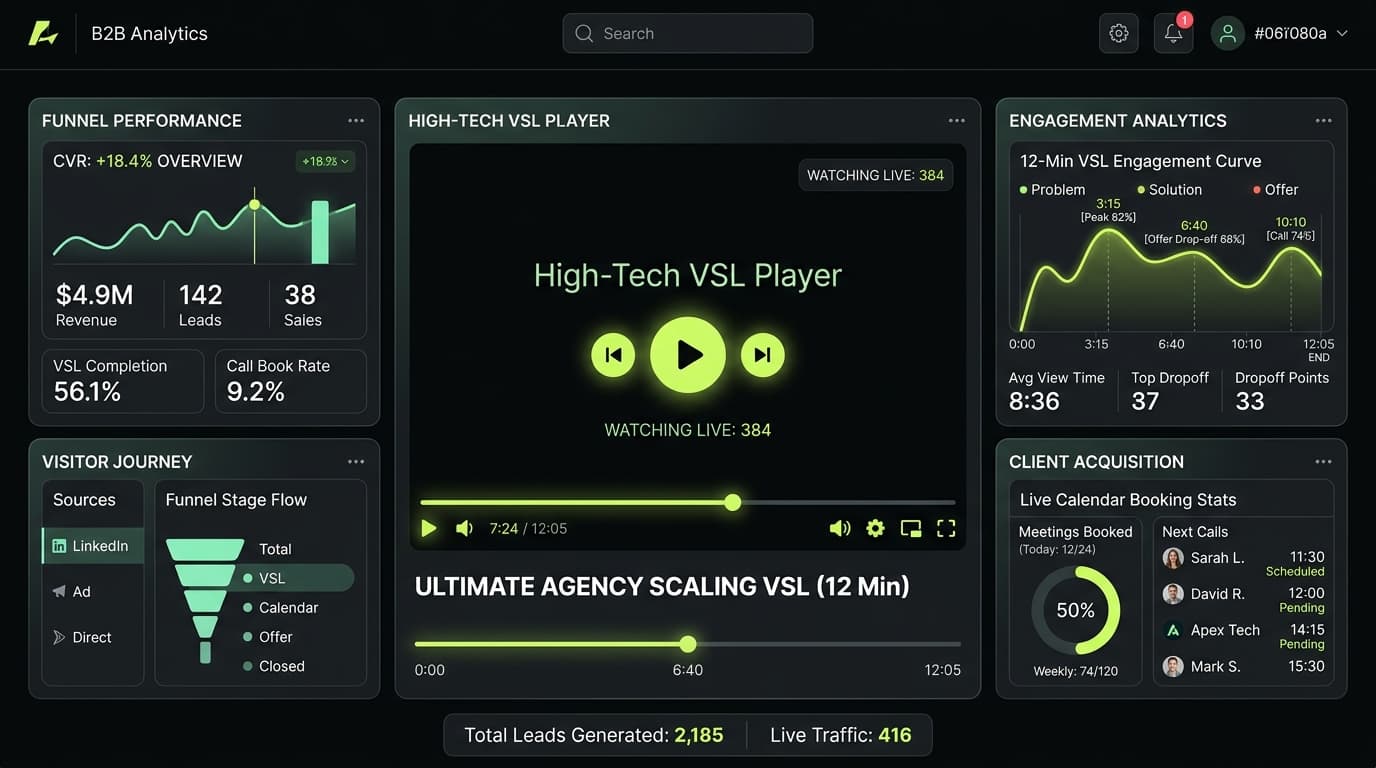
Screen recordings of ad accounts, CRMs and calendars outperform talking-head testimonials. Show the dashboard. If a client will go on camera, keep their clip to 20 seconds and cut to the number.
Address risk explicitly: written performance commitment, asset ownership, what happens if targets are missed. Risk reversal belongs here, not in the CTA.
7. Act 6: The Filtered Call to Action (11:00 to 12:30)
Tell People Who Should Not Apply
State exactly what happens next: 'Click below, answer six questions about your business, and if you qualify you will pick a time for a 30-minute strategy call where we map the system to your offer.' Remove every ambiguity about what the call is and is not.
Then filter. 'This is for businesses already doing $10K a month with an offer that works. If you are pre-revenue or looking for a course, this is not the right fit.' Counter-intuitively, the disqualifier raises application volume from qualified viewers because it signals scarcity and seriousness.
Close on the cost of waiting, tied back to the number from Act 2, and end. No second pitch, no bonus stack, no countdown timer. High-ticket buyers are repelled by low-ticket tactics.
- Describe the next step and the call in one sentence each.
- Name who should not apply.
- End within 90 seconds of starting the CTA.
8. Production Notes and the Mistakes That Kill VSL Conversion
Length, Pacing, Captions and Common Failures
Length: 10 to 14 minutes for high-ticket. Under eight minutes rarely builds enough belief for a $5,000+ decision; over 15 minutes loses completion. Track completion rate and application rate per minute of runtime and cut the segments where drop-off spikes.
Pacing: change the visual every 8 to 15 seconds (diagram, screen recording, talking head, text card). Caption everything; a large share of mobile viewers start muted.
Common failures: opening with a personal story instead of the viewer; listing features instead of a mechanism; vague testimonials; pricing on video; a CTA that says 'book a call' without explaining what the call is; and no disqualifier, which fills the calendar with people who cannot buy.
Iterate on data. Replace the hook first, then the proof order, then the mechanism visuals. A VSL is a living asset; the best performers are rewritten every quarter.
Strategic Conclusion
A VSL script for a high-ticket offer is not a pitch; it is a 12-minute argument that moves a qualified stranger from 'I have this problem' to 'I understand why their method works and I want to talk'. Six acts, strict timing, a named mechanism, specific proof and a CTA that tells the wrong people to leave. Paired with broad-targeted Meta ads to fill it, a qualification application behind it and 60-second follow-up after it, the VSL turns the strategy call from a cold pitch into a confirmation. QualifiedLeadsX writes, produces and tests this script as part of every funnel build. Book a free strategy call and we will outline the six acts for your offer on the call.
Common Questions Answered
How long should a VSL be for a high-ticket offer?
Ten to fourteen minutes. That is long enough to establish the problem, mechanism and proof needed for a $3,000 to $25,000 decision, and short enough to hold completion rates above 55%. Low-ticket offers can run shorter; webinars are usually too long.
Should the VSL mention price?
No. The VSL sells the strategy call, not the engagement. Pricing on video invites comparison before the prospect understands the mechanism. A qualifying statement about investment capacity ('businesses in a position to invest $3K to $10K') is appropriate in the CTA filter.
Do I need to appear on camera?
A founder or lead strategist on camera builds trust fastest, but a mix of talking head, diagrams and screen recordings outperforms a full talking-head VSL. If you dislike camera work, a 20% on-camera, 80% screen and diagram ratio still converts.
What is a unique mechanism in a VSL?
The named method that explains why your offer produces the result where alternatives fail. It should have a name, three to five components and a reason for the order of those components. It is the part of the script prospects repeat on the call.
How do I know if my VSL script is working?
Track three numbers: video completion rate (target 55%+), page-to-application rate (target 14% to 18%) and the share of applications that meet your qualification criteria (target 40%+). If completion is high but applications are low, fix the CTA. If applications are high but unqualified, fix the hook and the filter.
QualifiedLeadsX™ Research Team builds and scales customer acquisition funnels for elite high-ticket coaches, consultants, and growth agencies. Over $150M+ in client revenue scaled across North America, Europe, and the Middle East.